
The equipment.
Manufacturers supply the charger and its control electronics. Compare the exact model, output envelope, protection, warranty, installation scope and available maintenance.
TOBOR hardware →Looking for the best EV charging in India? Start with what you need: a place to charge today, a charger for your property, or a network for your fleet. Each calls for a different comparison.
By TOBOR · Published
A selection guide from TOBOR, a supplier of EV chargers, software and industrial battery storage.
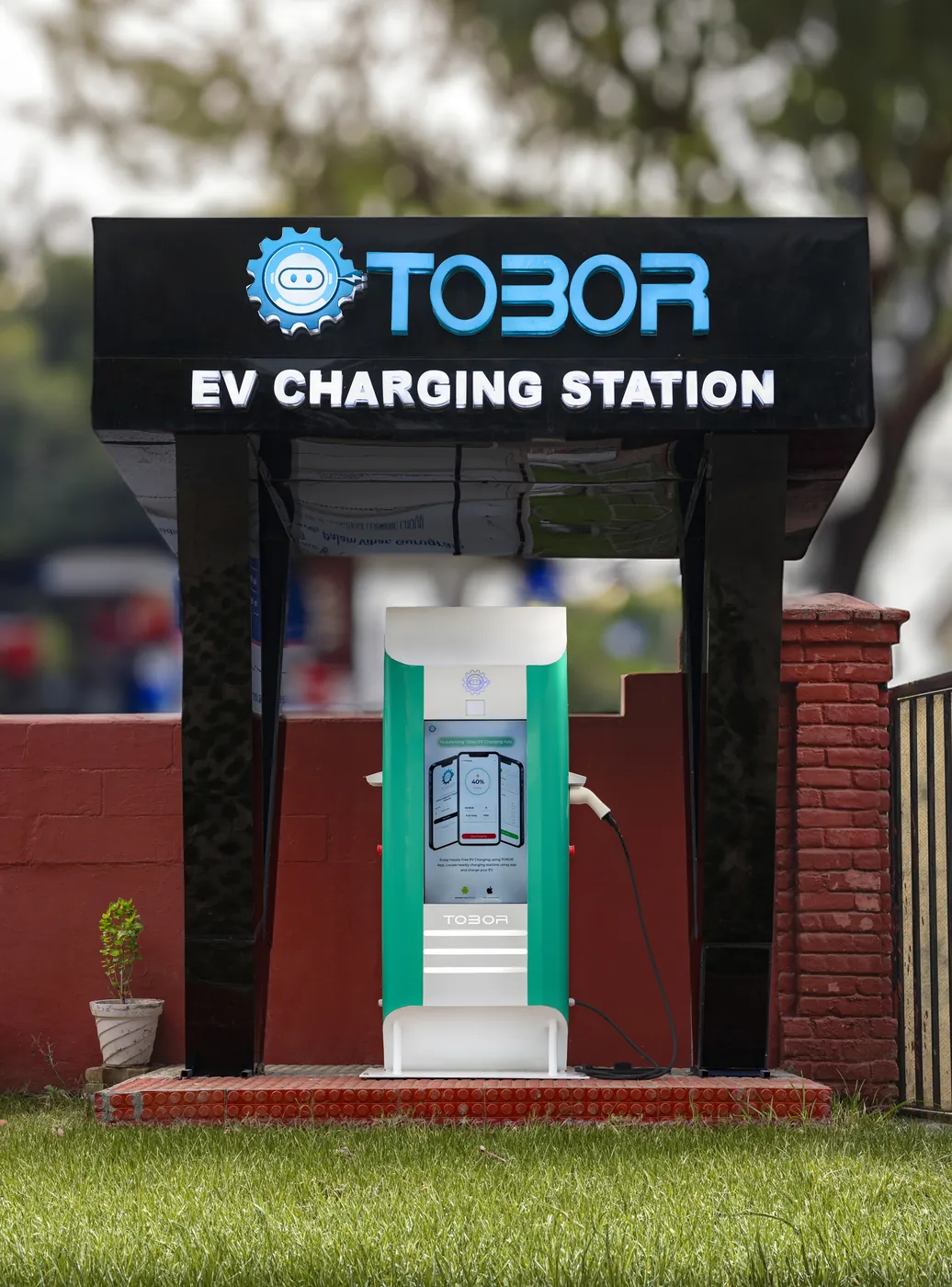
A high power rating or a large network does not answer every question. Match your choice to the vehicle, the location and the time available.
| You need | What matters | TOBOR options |
|---|---|---|
| A charging stop | A compatible charger on your route, current availability, public access, opening hours, total session cost and support. | Find chargers with the Tobor app → |
| Home or destination charging | Vehicle AC acceptance, parking duration, supply phase, electrical capacity, metering and access control. | Explore AC charging → |
| A fleet or public charging hub | Vehicle mix, session demand, turnaround time, connector power sharing, grid capacity and service response. | Explore CCS2 DC charging → |
| Two- or three-wheeler charging | The exact vehicle inlet, battery voltage, supported protocol and required turnaround time; light EVs use different charging systems. | Explore Type 6 & Type 7 → |
On smaller screens, scroll the table horizontally to compare all columns.
A company may handle more than one role. Ask who owns each part of your experience and who resolves a problem.
Manufacturers supply the charger and its control electronics. Compare the exact model, output envelope, protection, warranty, installation scope and available maintenance.
TOBOR hardware →The charge-point operator manages station operation. Compare access, pricing, uptime records, fault response and payment support at the sites you actually plan to use.
Tools for operators →An app helps drivers find and use supported chargers. Check which locations it serves, whether a session can start through it, payment terms and the route to support.
The Tobor app →For a network, review station-level coverage, recent availability and support experience. For a supplier, ask for the proposed model's datasheet, applicable test documentation, warranty and service scope. Request deployment references that match your use case.
OCPP describes charger-to-management communication. Support for it does not by itself establish that every vehicle, app, backend or roaming network will work together. Validate the intended integration.
A vehicle must accept the power offered. AC charging also depends on its onboard charger; DC power changes with battery state and temperature. At a multi-connector site, ask how power is shared when more than one vehicle charges.
For example, adding 30 kWh at an average delivered 30 kW takes approximately one hour of energy delivery. A charger's peak rating alone cannot guarantee that average.
The electrical connection, daily demand and parking pattern determine the site design. A complete quote should make these assumptions explicit.
Plan a charging site →Record vehicle models, compatible connectors, daily energy needs, arrival times and the number of simultaneous sessions.
Share sanctioned load, existing peak demand, parking layout, cable distances and expansion plans. Have the electrical design, protection and approvals reviewed for the site.
Decide public or private access, billing responsibility, software integration, support contacts and maintenance response expectations.
Compare charger hardware, electrical and civil work, commissioning, connection upgrades, software fees, payment charges, energy bills and maintenance over the same period.
TOBOR designs EV charging hardware and software in Gurugram, India, with an industrial BESS range for projects that need stored energy alongside charging.
AC charging: 3.3 kW socket charging and 7.2, 11 and 22 kW Type 2 options for longer parking periods.
CCS2 DC charging: 30 and 60 kW models, with 120 and 240 kW configurations to order. Select the voltage, current and connector configuration for the vehicle mix.
Light-EV charging: Type 6 and Type 7 options for compatible two- and three-wheelers.
Connected operations: TOBOR CSMS for charger management and the Tobor app for drivers using supported chargers.
Industrial storage: 500 kW to 10 MW BESS configurations. A battery can buffer short peaks above the grid connection's capacity; usable energy and recharge windows determine how long it can sustain that demand.